AI SEO Audit vs Manual Audit: What Wins?
Compare ai seo audit vs manual audit for speed, accuracy, and actionability. See when each works best and how to fix SEO faster.
If your team has ever opened a 70-page SEO report and thought, now what, you are asking the right question. The real debate in ai seo audit vs manual audit is not whether software is smarter than people. It is whether your business gets a clear, prioritized path to fixes before rankings, traffic, and revenue slip.
For most growing companies, the bottleneck is not finding problems. It is turning problems into action. That is why this comparison matters. An audit is only useful if it helps marketing, content, and development teams decide what to do next without losing a week translating jargon.
AI SEO audit vs manual audit: the real difference
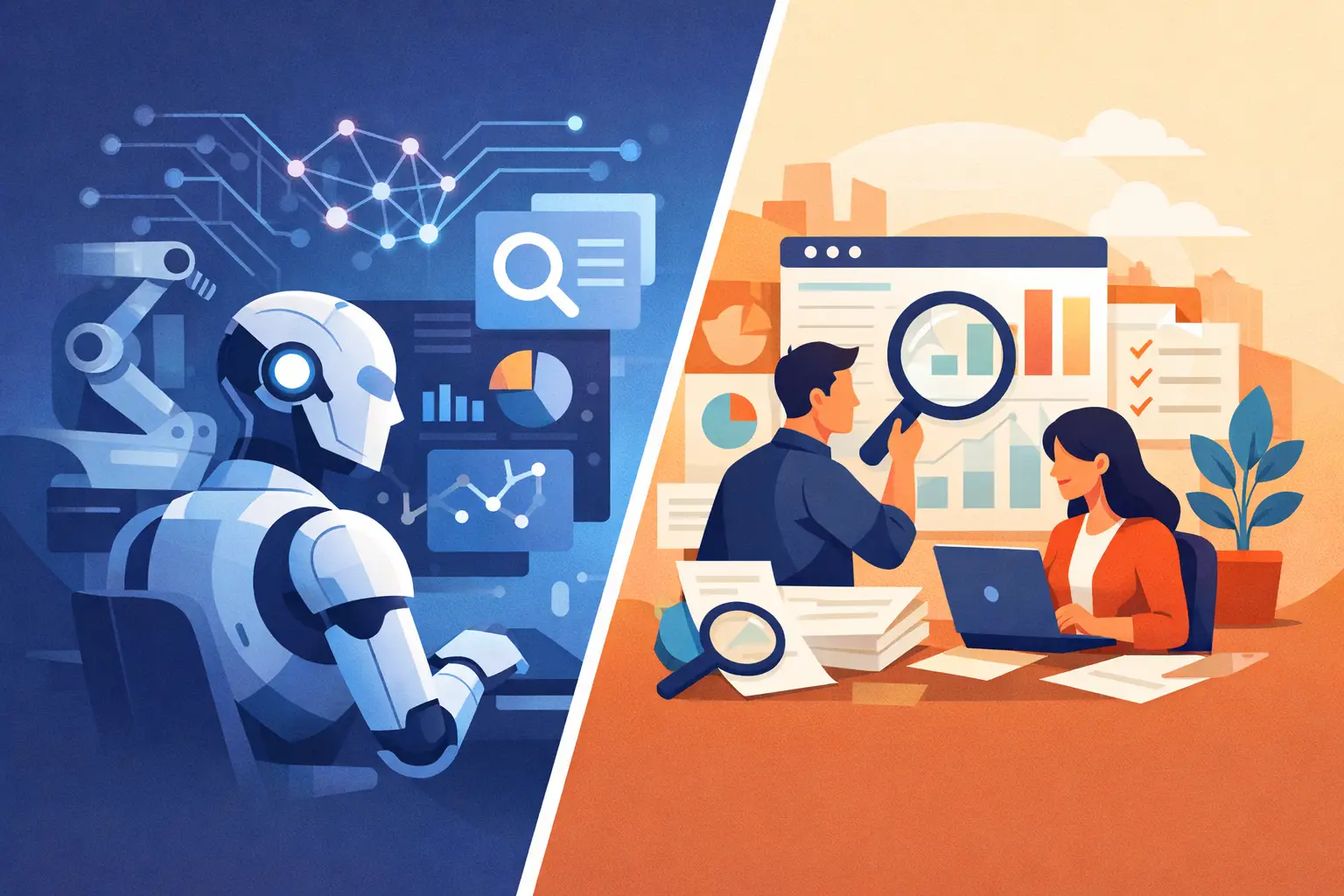
A manual audit is led by an SEO specialist who reviews your site, interprets data, and writes recommendations based on experience. An AI audit uses software to crawl pages, evaluate issues at scale, connect multiple data sources, and organize findings quickly.
On paper, that sounds simple. In practice, the difference shows up in speed, consistency, coverage, and how easy the output is to use.
A manual auditor can spot nuance. They can look at a category page, understand business context, and say, this template is technically fine but the search intent is off. They can factor in brand positioning, content quality, and internal politics. That kind of judgment still matters.
An AI-powered audit is better at handling volume and repetition. It does not get tired halfway through 800 pages. It will apply the same checks across your site, flag patterns, connect performance data, and surface issues that would take a human much longer to compile. If the system is built well, it also turns that analysis into a usable to-do list instead of a pile of raw findings.
That last part is where many teams get stuck. Fast audits are easy to promise. Actionable audits are harder.
Where manual audits still earn their keep
Manual reviews are strongest when your site has unusual complexity or when strategy matters more than detection. If you are migrating domains, changing information architecture, consolidating content, or diagnosing a ranking drop tied to a specific business event, experienced human review can catch subtleties a rules-based system may miss.
Manual audits are also useful when leadership wants interpretation, not just issue lists. A seasoned consultant can explain trade-offs, mediate between marketing and engineering, and tailor recommendations to your resources. That is especially valuable if your internal team is small and needs strategic guidance more than technical scanning.
The trade-off is cost and time. A deep manual audit can take days or weeks. It may also depend heavily on the individual doing the work. One consultant gives you a clear roadmap. Another gives you a dense document full of caveats and vague next steps. Consistency is not guaranteed.
There is also the scale problem. Humans are good at judgment. They are less efficient at checking the same technical conditions across hundreds or thousands of URLs. When budgets are tight, manual audits often become sampled reviews rather than true sitewide analysis.
Where AI audits pull ahead
An AI audit shines when you need fast visibility across a real website, not just a handful of pages. It can crawl hundreds of URLs, run dozens of checks, compare technical signals against live search and performance data, and surface patterns that matter right now.
That matters for lean teams. Most small and mid-sized businesses do not need a philosophical essay about canonical tags. They need to know which pages are blocked, which templates are slow, where metadata is broken, whether schema is missing, and what should be fixed first.
A good AI system also removes one of the biggest problems in SEO reporting: translation. Instead of handing your team raw crawl exports, it can explain issues in plain English, estimate impact, and package fixes in a way developers can actually use.
This is why AI is not just about speed. It is about operational fit. If your SEO workflow depends on pulling data from five tools, stitching together screenshots, and rewriting recommendations for stakeholders, the audit itself becomes overhead.
When the platform combines crawl analysis with real Google data, it gets even more useful. You are not just seeing what is technically wrong. You are seeing what is wrong on pages that already matter for impressions, clicks, and conversions. That helps teams stop treating every issue like an emergency.
AI SEO audit vs manual audit for accuracy
Accuracy is where people often assume manual wins automatically. Not always.
A human reviewer may be better at contextual judgment, but humans also miss things, especially on larger sites. They sample pages. They make assumptions. They get inconsistent when reviewing the same issue across multiple templates.
AI is generally more reliable at repetitive technical validation. It can apply the same checks across every page without drift. If your goal is to identify missing title tags, redirect chains, thin content patterns, indexability issues, Core Web Vitals concerns, or broken internal linking at scale, automation usually produces broader and more consistent coverage.
But accuracy is not just detection. It is prioritization.
A tool that flags 300 issues without context is technically accurate and still not helpful. A manual auditor might do better at saying, ignore these low-value warnings and focus on the product pages losing organic traffic. The best modern audit systems close that gap by layering business impact and supporting data onto the findings, so teams know what deserves attention first.
That is the sweet spot. Not AI alone. Not manual alone. AI-supported analysis that produces human-usable decisions.
What most businesses actually need
Most businesses do not need a pure manual audit or a pure machine dump. They need three things.
First, they need broad technical coverage. Second, they need findings tied to real performance data. Third, they need outputs that are clear enough for marketers and specific enough for developers.
That is why the old agency-style model feels heavy for many teams. You wait, you pay a premium, and you receive a report that still needs interpretation before anyone starts fixing issues. The result is often delay, not momentum.
An AI-first approach works better when it is designed around execution. That means prioritized recommendations, plain-English explanations, and implementation-ready outputs instead of scary dashboards and endless exports.
For a lean ecommerce team, that could mean identifying category pages with weak internal links and poor load times, then connecting those issues to pages already generating impressions. For a startup, it might mean catching indexation and schema problems before they limit discoverability. For an in-house marketer, it means not having to become a technical SEO translator overnight.
When to choose one over the other
Choose a manual audit when your problem is highly strategic, unusual, or politically sensitive. If you need a senior expert to guide a migration, resolve a messy SEO history, or advise on content and architecture trade-offs, human input is worth paying for.
Choose an AI audit when you need answers quickly, need sitewide coverage, or need a repeatable process your team can actually use month after month. That is especially true if your site changes often and a one-time report will go stale fast.
For many teams, the most practical answer is to start with an AI-powered audit and use manual review only where nuance is required. That keeps costs under control while still giving you expert-level visibility. It also prevents the common mistake of spending heavily on interpretation before you have even established the baseline problems.
A platform like WhatSEO.ai fits that operating model well because it does not stop at finding issues. It connects crawl analysis with Google Search Console, GA4, PageSpeed Insights, and CrUX data, then turns the findings into a prioritized action plan your team can move on. That is a much better fit for businesses that want agency-quality analysis without the agency drag.
The better question than AI or manual
Instead of asking which method is superior in theory, ask which one helps your team fix the right things this week.
If an audit is fast but shallow, it will create false confidence. If it is thoughtful but slow, it may arrive after the opportunity has passed. If it is accurate but unreadable, nothing gets implemented.
The winning audit is the one that closes the gap between diagnosis and action. For most modern teams, that means using AI to handle scale, consistency, and prioritization, while saving human judgment for the moments that truly need it.
SEO should not become a side job for your marketing lead or a mystery project for engineering. It should run quietly in the background, with clear signals, sensible priorities, and fixes that are easy to ship. That is usually not a question of man versus machine. It is a question of whether your audit helps the business move.